— Bikash Sahoo
There’s a thrill in doing fieldwork that comes from not knowing what you’ll stumble upon as you dig through leaf litter, turn over logs, or simply follow a trail of insects into the undergrowth. For me, this thrill came alive during a memorable expedition into the beautiful forests of the Western Ghats.
As part of my Ph.D. research on army ants, I’ve travelled across the Eastern and Western Ghats, always on the lookout for elusive Aenictus species. On one particular day (26th April, 2022), I found myself in Karnataka’s Pushpagiri Wildlife Sanctuary with fellow researchers Avrajjal, Vivek, and one local guide. We were spread out, scanning the forest floor, when Vivek, who was actually on the lookout for reptiles, lifted a large, rotting log.
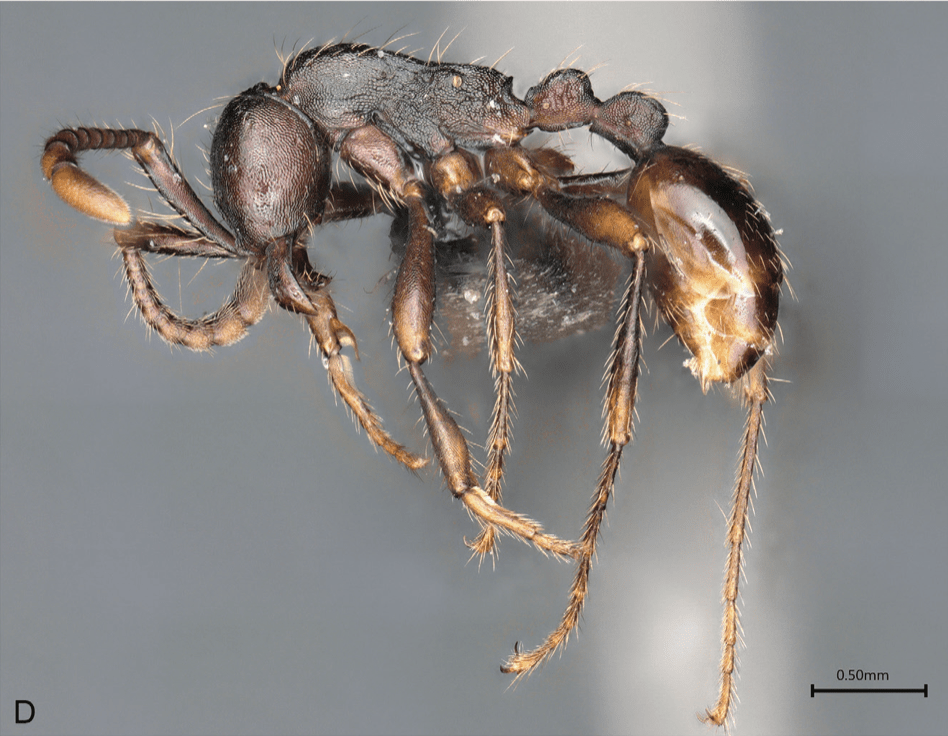
From beneath the log burst a swarm of ants, clearly agitated by the disturbance. “Bikash, come here! Ants!” Vivek called out. I rushed over, and as soon as I saw them, my heart skipped a beat. That wasn’t just any ant colony; that was a species I had been hoping to find. I quickly collected a few specimens, excited to study them in the lab.
Three weeks later (19th May 2022), the adventure continued in the Kadalar tea estate of Kerala. As we were exploring the estate, I noticed a few ants moving across a rock. I crouched down for a closer look, Aenictus again! Another lucky find. I collected them, not expecting just how significant this would turn out to be.
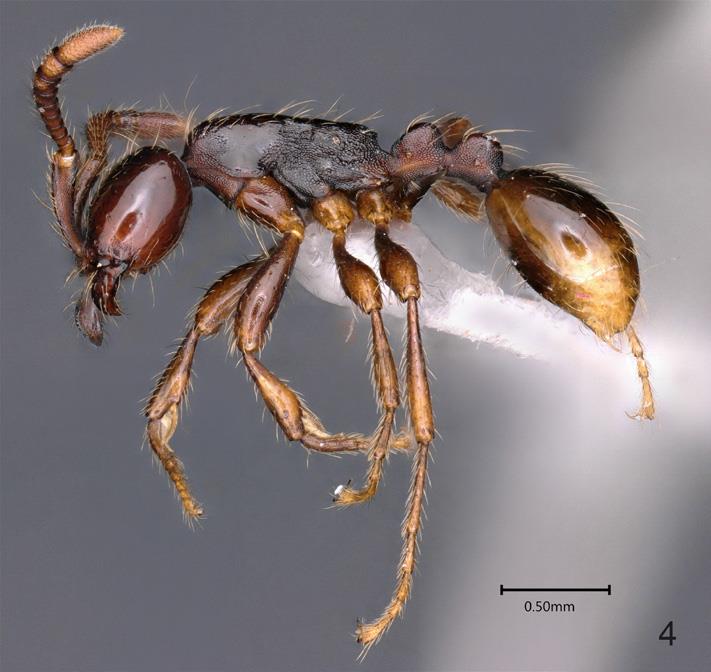
Back at the lab in NISER, as I began sorting through the specimens, something curious stood out. The ants from Pushpagiri and Kadalar looked quite different from any I had seen before. Their morphology didn’t match any described species in the genus. Intrigued, I sequenced their DNA and built a phylogenetic tree to compare them with known Aenictus species.
The results were striking.
Both species formed distinct lineages on the tree, separate from all known species. A deeper morphological comparison confirmed the same; they were not only genetically distinct, but also morphologically unique. It was a surreal moment. In the middle of routine fieldwork, we had stumbled upon not one, but two new species of army ants. Working with my collaborators, we formally described the species and named them in honor of the beautiful places where they were found. The ants from Pushpagiri Wildlife Sanctuary were named Aenictus kodaguensis, a tribute to the Kodagu district of Karnataka. The ants from Kadalar became Aenictus kadalarensis, linked to the misty tea estate in Kerala.
These discoveries are a reminder that nature often keeps its secrets well. With a careful eye, a curious mind, and a bit of luck, even a simple walk through the forest can unfold into a discovery that rewrites what we know about the natural world.
Read more about Aenictus kadalarensis and Aenictus kodaguensis.
 BioGeoSys